
- What Is the DISSONA Brand?
- Is DISSONA a Luxury Brand?
- How Much Is a DISSONA Bag?
- Is a DISSONA Bag Worth It? (Pros & Cons Analysis)
- 👍 Its Strengths: Solid Foundations, Practicality, and Timeless Appeal
- 👎 Its Weaknesses: Inconsistent Quality Control and Limited Brand Recognition
- “Good” Depends on the Lens
- The Value Equation
- “Worth It” by Buyer Type
- Who Should Buy DISSONA
- Should You Buy It?
- Who Is DISSONA Suitable For?
- Head-to-Head at the Same Money
DISSONA is a Chinese original luxury leather goods brand founded in 1985. Its core customer base consists of urban white-collar professionals who value quality. It is often described as a go-to brand for professionals working in the public sector or as the “Chinese Coach.”
The brand insists on using genuine, high-quality materials, including full-grain cowhide, and has introduced former Hermès artisans to oversee its craftsmanship. Its leather texture and workmanship stand out within its price range. Its designs lean towards an intellectual, practical style suitable for everyday commuting, offering generous capacity while maintaining a reasonable weight. Overall, the brand offers excellent value for money.
DISSONA products are generally priced between RMB 1,100 and RMB 5,000 (approximately USD 150–750), making them more cost-effective than other affordable luxury brands such as Coach and Michael Kors.
DISSONA has gradually gained increasing attention and popularity, demonstrating, to some extent, the advantages of Chinese manufacturing and the rise of Chinese accessible luxury brands.
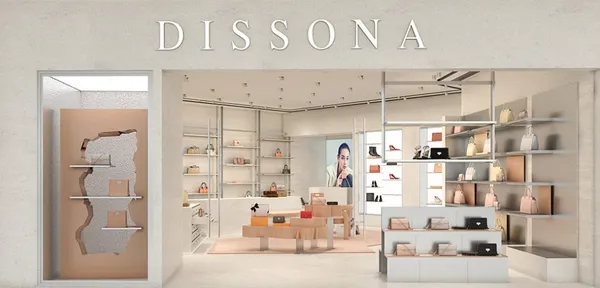
What Is the DISSONA Brand?
DISSONA is an original Chinese premium leather goods brand dedicated to providing urban women with leather products that combine elegance and vitality. Positioned in the accessible luxury segment, the brand emphasizes craftsmanship and original design, and aims to establish a strong presence amid competition from both domestic and international brands.
What Is DISSONA?
DISSONA (Chinese name: 迪桑娜) is a Shenzhen-based leather goods brand specializing in handbags and footwear for urban women. It is operated by Dejin Industrial Development (Shenzhen) Co., Ltd. Its slogan is “Making Good Bags and Shoes, One Stitch at a Time.” The brand’s overall philosophy places craftsmanship at its core rather than chasing trends.
The brand is ranked among China’s leading handbag brands and has repeatedly appeared in the top ten of domestic leather goods and handbag rankings. It operates stores in Shenzhen, Guangzhou, Shanghai, Yunnan, and other locations, while also expanding its international sales network through overseas channels such as LazMall.
Origins and History
According to widely circulated accounts, the company was founded in Shenzhen in 1985, although some sources state that it was established in 1990. It initially manufactured products for luxury brands before eventually launching its own brand. This version of its history has been adopted by English-language fashion media and in the brand’s recent promotional materials.
2013 (some sources cite 2010): The brand introduced Thomas Maurice, a former Hermès artisan, to incorporate traditional European saddle-stitching techniques into its craftsmanship. It also established a dedicated handmade workshop. This is one of the most frequently mentioned turning points in the brand’s positioning.
February 2017: DISSONA became the first Chinese leather goods brand to appear at Milan Fashion Week. It subsequently made its debut at Shenzhen Fashion Week in March of the same year. Actress Dong Jie is currently the brand ambassador.
What Does It Actually Make?
Its core products are everyday leather bags featuring structured designs and soft textures. These include tote bags, top-handle bags, travel bags, shoulder bags and underarm bags, envelope bags, and so-called “toast” bags, as well as footwear and sports-inspired casual bags.
Materials are an important part of the brand’s story. They include carefully selected European leather, French full-grain calfskin, vegetable-tanned buffalo calfskin, reverse suede calfskin, and nubuck leather. Some high-end pieces even use ostrich leather.
According to reports, one product in its 2025 collection underwent 17 processing stages, including six to eight hours of hot rolling, and was made using French full-grain calfskin.
DISSONA has a distinctive brand identity built around woven leather. Its Zhixu (织序) collection reinterprets the traditional rice-pattern weaving technique found in Yongchun lacquer baskets from Fujian Province, translating it into leather craftsmanship. Other collections feature cross-weaving techniques and woven calfskin handles.
As a result, DISSONA is not only a benchmark for leather craftsmanship but also a direct competitor to woven and reed-woven bag concepts, achieving a similar aesthetic through leather rather than natural fibers.
Design Language
DISSONA’s design language combines urban fashion, contemporary art, and traditional Chinese aesthetics.
Its signature Zhixu (Weaving Order) collection draws inspiration from traditional Chinese bamboo weaving techniques, particularly the “rice-character” weaving pattern (米字编), reinterpreting the beauty of traditional craftsmanship through modern handbag structures.
Craftsmanship and Brand Positioning
The brand promotes a philosophy centered on independent research and development, in-house production, and its own manufacturing facilities. By combining intelligent production lines with dedicated handmade workshops, and maintaining long-term partnerships with renowned tanneries, it secures priority access to premium leather materials.
One of its signature techniques is the “Five Oils and Three Polishes” edge-finishing process, which is applied to seams, corners, and strap details.
Rather than focusing purely on luxury aesthetics, its leather products emphasize practicality. Materials include vegetable-tanned cowhide, young buffalo leather, suede cowhide, and signature coated canvas. Vegetable-tanned leather is particularly prominent, as it develops a natural patina over time and offers a degree of water resistance.
Key Brand Information
Brand Background
DISSONA’s parent company, Dejin Industrial, was founded in 1985, while the DISSONA brand itself was established in the early 1990s. The company has accumulated approximately 40 years of experience in leather craftsmanship.
Brand Positioning and Philosophy
Positioned in the accessible luxury segment, DISSONA primarily targets white-collar women. Its handbags are generally priced between RMB 1,000 and RMB 5,000.
Its design philosophy emphasizes being “youthful yet sophisticated, elegant yet energetic.” The brand is committed to creating quality handbags driven by both creativity and craftsmanship.
Its guiding principle is: “Making Good Bags and Shoes, One Stitch at a Time.”
Craftsmanship
DISSONA places great importance on the heritage and preservation of traditional craftsmanship. Its chief leather artisan is Thomas Maurice, a craftsman from France. The brand also claims to have inherited techniques associated with artisans who once served the French president.
It is also described as the first high-end leather goods brand in China to establish its own haute couture workshop. Through events such as its “Leather Haute Couture Workshop Art Exhibition,” the brand showcases its production processes and craftsmanship to consumers.
Design Innovation
While remaining committed to original design, DISSONA also focuses on combining traditional culture with modern design.
For example, its 2024 Zhixu collection was inspired by the traditional intangible cultural heritage bamboo-weaving technique known as “rice-character weaving” (米字编), which originates from Yongchun lacquer baskets in Fujian Province.
Key Facts
| Name | DISSONA / 迪桑娜 |
| Origin | Shenzhen, China — started as a small workshop in 1985; brand registered in the mid-1990s; operating entity (formerly 深圳市迪桑娜皮具有限公司, now 深圳市德艺科技实业有限公司) incorporated 2002 |
| Parent | 德津实业发展(深圳)有限公司 (Dejin Industrial), which also runs GILLIVO and DANIE HECHTER |
| Category | Mid-to-high-end genuine-leather women’s bags, plus women’s shoes (added 2011), small leather goods, straps/charms, and a haute-customisation line |
| Positioning | Chinese “affordable premium / light luxury” — below European luxury houses, above fast fashion; often compared with Coach on price but with a quieter, more understated aesthetic |
| Target | Urban working women ~25–45; historically “commute bag,” now reframed as “new commute / ease / breathing / comfortable urban philosophy” |
| Price | Entry ~RMB 998–1,300; core line roughly RMB 1,000–3,000; high-end/custom pieces above RMB 3,000 (e.g. a monogram tote at ¥1,978, toast bag from ¥1,299) |
| Retail | Several hundred offline stores in premium malls and department stores — sources range from 250+ in a 2026 brand release to 600+ including franchise/group counters; plus Tmall, Douyin, Xiaohongshu |
| Milestones | 2013: partnered with French leather master Thomas Maurice (widely reported as a former Hermès artisan) to bring saddle stitching and edge-finishing into China and open the country’s first leather-goods haute-customisation workshop; 2017: first Chinese leather-goods brand on the official Milan Fashion Week calendar; 2020: second-generation lead Crystal (陈斯曼) took over |
Common Misconceptions
❌ It is not an Italian or French brand. Its name and promotional references to an “Italian Design Center” have led many buyers to assume that it is a European brand. In reality, DISSONA is a Shenzhen-based Chinese brand that collaborates with European designers and leather tanneries.
❌ It is not a wholesale brand from Baiyun or Guihuagang, nor is it an Hermès-level exclusive boutique. It occupies a middle-ground position: using genuine leather, operating its own factories, selling through department store counters, and offering products priced in the four-digit RMB range.
❌ It does not fall into the low-end category of so-called “genuine leather” products. Its positioning is based on carefully selected full-grain and vegetable-tanned leather, rather than bonded leather or processed split leather, as explained earlier.
⚠️ The number of stores and the year of establishment vary depending on the source (a workshop dating back to 1985 versus a legally registered entity established in 2002; 250, 370, or more than 600 stores). This is because the figures combine the brand’s history, its legal entity, and the overall number of franchised stores across the group.
Is DISSONA a Luxury Brand?
No. DISSONA is not a top-tier luxury brand in the traditional sense. Rather, it is a clearly positioned accessible luxury brand. It represents a strong challenge from a Chinese homegrown brand seeking to move into the high-end market.
Why Do People Think DISSONA Is a Luxury Brand?
There are four factors behind this confusion:
1. Its use of the term “Haute Couture” and its Italian design narrative.
The brand uses the term “Haute Couture” on its official website and promotes a narrative centered around its “Italian Design Center.” These are marketing terms, not official recognition or certification within the Parisian haute couture system.
2. Its association with Hermès.
Thomas Maurice introduced European saddle-stitching techniques and leather edge-finishing techniques into the Hermès workshops.
3. Its appearance at Milan Fashion Week in 2017.
DISSONA became the first Chinese leather goods brand to appear on the official Milan Fashion Week schedule. This was indeed a milestone, but it represented an increase in brand exposure rather than an upgrade in luxury status.
4. Using craftsmanship as a marketing strategy.
Its 2025/2026 factory livestreams, featuring brand ambassador Dong Jie, emphasize craftsmanship that is “on par with international luxury standards.” The brand has also opened a concept store at Shenzhen MixC.
Pay attention to the pattern here: all these claims focus on manufacturing techniques and craftsmanship rather than exclusivity or pricing power. This is a typical characteristic of brands seeking to borrow the credibility and prestige associated with luxury.
Why Is It Not Considered “True Luxury”?
1. Price Ceiling
Entry-level products from genuine luxury brands typically start at over USD 1,500, rather than USD 100–700. DISSONA’s mainstream pricing overlaps considerably with COACH. Analysts have pointed out that, within a similar price range, its brand premium is actually slightly lower than that of COACH.
2. Luxury Positioning Is a Strategy, Not a Status Symbol
The brand describes itself as “China’s Hermès” and frequently uses terms such as “luxury” and “Haute Couture” in its promotional materials. However, the aspiration conveyed through marketing language does not necessarily translate into the level of luxury perceived by the market.
3. Its Actual Competitors
Its real competitors are COACH, Michael Kors, MCM, and other domestic Chinese brands. It occupies a transitional segment ranging from affordable to premium, rather than the core segment of the true luxury market.
4. Product Quality and Consumer Feedback
At the same price point, its product quality performs well, but consumer feedback is mixed. Some reviewers have praised its solid construction, good workmanship, and refined details. Others, however, have reported wear and tear after prolonged use, as well as fading of metal hardware. These are relatively common issues within this price segment.
A Clearly Defined Accessible Luxury Positioning
According to DISSONA’s official brand information, the brand is positioned in the accessible luxury segment.
Its target customers are urban white-collar women, with most of its products priced between RMB 1,000 and RMB 5,000 (approximately USD 150–750).
This price range clearly reflects its market positioning: significantly above mass-market brands, but still below the price threshold of top-tier luxury brands such as Chanel and Hermès.
Craftsmanship That Aspires to Luxury Standards
Although DISSONA is positioned as an affordable luxury brand, it does benchmark itself against luxury brands in terms of craftsmanship and design.
1. Inheriting High-End Craftsmanship
The brand’s chief leather craftsmanship master, Thomas Maurice, was a senior leather goods artisan at Hermès. The brand also claims to have inherited craftsmanship from artisans who once served the French president, and has invited traditional Italian artisan families to participate in the development of its haute couture collections.
2. International Design and Materials
DISSONA sources premium leather materials from Europe, including rare materials such as crocodile leather and ostrich leather for its haute couture product lines. It also brings in designers and artisans who have previously worked for internationally renowned luxury brands.
The average price of its haute couture collections can exceed RMB 10,000 (approximately USD 1,500).
3. Industry Recognition
In 2017, DISSONA became the first Chinese leather goods brand to appear at Milan Fashion Week. This provided a degree of recognition for its design and craftsmanship.
How Does It Compare?
| Brand | General positioning |
|---|---|
| Hermès | Ultra-luxury |
| Chanel | High luxury |
| Gucci | High luxury |
| Coach | Accessible luxury |
| Michael Kors | Accessible luxury |
| DISSONA | Chinese premium / affordable luxury |
| Charles & Keith | Contemporary affordable fashion |
The Three-Lens Test
| Lens | DISSONA | Luxury house? |
|---|---|---|
| Price & shelf | Entry ~RMB 998; core ¥1,000–3,000 (most listed SKUs ¥1,198–2,598); higher lines to ~¥5,000 | ❌ Overlaps Coach / Michael Kors, not LV/Hermès. One consumer analysis puts it bluntly: “more expensive than ordinary brands, but doesn’t reach luxury entry” |
| Distribution | 600+ counters in malls/department stores + Tmall/Douyin/Xiaohongshu; frequent online promotions | ❌ Luxury is built on scarcity, controlled distribution, no discounting. 600 doors is mass-premium reach |
| Brand equity | Recognised as mid-to-high-end in Chinese brand directories; 40 years of history, 2017 Milan Fashion Week, “Shenzhen Famous Brand” 2025 | ❌ No quota system, no resale premium, no global aspirational pull, weak mindshare among young tier-1 shoppers |
| Craft & materials | ⭐ Genuinely serious: own Shenzhen factory + hand atelier, French full-grain calf, 17-stage leather treatment, saddle stitching via former Hermès artisan Thomas Maurice (2013), “five coats, three sandings” edge paint, 200+ hand operations | ✅ This part is luxury-grade |
How Much Is a DISSONA Bag?
DISSONA bags cover a relatively wide price range, with the brand primarily positioned in the RMB 1,000-level accessible luxury market. Its main price range is approximately USD 60–450, while some high-end collections and special-material designs can reach around USD 600.
Overall, its pricing places it in the same competitive segment as international accessible luxury brands such as COACH and Michael Kors, although DISSONA is generally slightly more affordable.
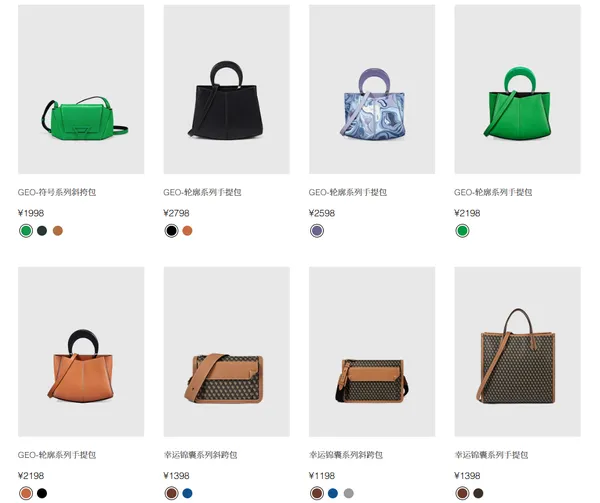
Price Range Overview
Entry-Level / Basic Styles (Approximately RMB 500–1,000)
This price range mainly includes small leather goods, simple crossbody bags, and promotional items.
For example:
- A cowhide bucket-style phone bag can cost around RMB 529 after discounts.
- Some candy-colored chain bags and Moonlight collection crossbody bags are priced at approximately RMB 750–850.
- Certain small “Folded Ear” bags featuring signature coated canvas and leather patchwork can be discounted to as low as RMB 954.
Core Collection / Mainstream Styles (Approximately RMB 1,000–3,000)
This is DISSONA’s main price segment, covering most of its genuine leather commuter bags, popular collections, and celebrity-endorsed styles.
Lucky Pouch Hobo Bag: As one of the brand’s key styles for 2026, the small size costs approximately RMB 1,198 after coupons, while the large size costs around RMB 1,482. The official retail price of the large size is approximately RMB 2,599.
Other Popular Styles:
- The quilted chain bag in the same style worn by Qi Wei is priced at approximately RMB 850.
- The snakeskin crossbody mini bag in the same style worn by Liu Wen is priced at approximately RMB 2,798.
- The Folded Ear bag collection generally ranges from RMB 778 to RMB 1,395.
- Small woven leather crossbody bags are priced at approximately RMB 1,622.
High-End / Special-Material Styles (Approximately RMB 3,000–4,000+)
This category includes products made from rare leather materials (such as snakeskin and lizard-pattern leather), designs featuring more complex craftsmanship, and pieces from the haute couture collection.
For example, the snakeskin mini bag in the same style worn by Liu Wen is listed at RMB 2,798. Some limited-edition or specially designed pieces can reach the RMB 3,000–4,000 price range.
DISSONA Handbag Price Guide
| Category | RMB | USD |
|---|---|---|
| Small / sale bags | ¥400–800 | $60–120 |
| Everyday handbags | ¥800–1,600 | $120–240 |
| Premium leather bags | ¥1,600–2,500 | $240–375 |
| New / special collections | ¥2,500–3,000 | $375–450 |
Price by Collection
| Collection | List (CNY) | USD | Street (CNY) | Notes |
|---|---|---|---|---|
| 幸运锦囊 Lucky Pouch (monogram) | ¥998–1,898 | $150–285 | ¥848–1,798 | The volume/entry line |
| 回声 Echo (veg-tan calf) | ¥1,998–2,998 | $300–450 | ¥1,648–2,698 | Current hero line, Dong Jie ambassador |
| 织序 Zhixu (woven leather) | ¥1,298–3,548 | $195–530 | ¥1,298–2,535 | ⭐ Direct adjacent to a raffia concept |
| GEO / 至简 / 信函 / 环游 | ¥1,998–3,998 | $300–600 | ¥1,798–3,058 | Structured, higher-positioned |
| Woven counter exclusives | ¥2,998–4,698 | $449–700 | ¥2,698–4,228 | Mall-only, hand-woven leather |
Key Factors That Affect Pricing
Collection and Popularity: Prices tend to remain relatively firm for the brand’s flagship collections, such as the “Lucky Pouch” series, and celebrity-endorsed styles, including collaborations or styles associated with Qi Wei and Liu Wen.
Materials: Regular cowhide styles make up the majority of the collection. However, designs featuring special materials such as snakeskin, lizard-pattern leather, or higher-grade leather tend to be significantly more expensive.
Size: Within the same collection, larger sizes are usually several hundred RMB more expensive than smaller ones. For example, the price difference between the large and small Lucky Pouch Hobo bags ranges from RMB 300 to RMB 1,000.
Shopping Channels and Promotions: Promotional prices and coupon-adjusted prices on online e-commerce platforms such as JD.com and Taobao are generally lower than the listed retail prices at physical stores. The discount available will affect the final purchase price.
Is a DISSONA Bag Worth It? (Pros & Cons Analysis)
DISSONA is a highly practical accessible luxury brand with very distinct strengths and weaknesses. Whether it is “worth it” depends on whether you place greater importance on solid materials and craftsmanship or consistent quality control and fashion-related social appeal.
👍 Its Strengths: Solid Foundations, Practicality, and Timeless Appeal
If you are looking for a product whose quality becomes apparent through everyday use, DISSONA delivers performance that exceeds expectations in many aspects for its price range.
1. Genuine Materials and a Strong Foundation in Craftsmanship
Founded in 1985, the brand has accumulated nearly 40 years of experience in the leather goods industry. It insists on using genuine leather, such as vegetable-tanned young bull leather and Dutch dairy calfskin. Some product lines have even introduced former Hermès artisans to oversee craftsmanship.
Many users report that the leather feels soft, smooth, firm, and resilient to the touch, offering an outstanding texture compared with other products in the same price range.
2. Consistent Material Quality
Most of its core styles are made from carefully selected full-grain cowhide, including French calfskin and milk calfskin.
Many buyers comment that the leather feel, stitching, edge finishing, and interior lining are all superior to those of many imported mid-range brands in a similar price range, such as Coach and MK.
3. A Practical Design Philosophy
DISSONA’s designs lean towards an intellectual and elegant commuter style. Rather than chasing exaggerated fashion trends, the brand combines modern design with subtle elements of Chinese culture, resulting in styles that remain appealing over time.
Popular styles such as the “Folded Ear” bag are lightweight yet spacious, easily accommodating a 13-inch laptop. This makes them particularly suitable for professional settings. Some users consider them a choice for people who appreciate quality without needing to show it off.
4. Reliable After-Sales Service
The company offers lifetime free repairs for its leather bags, reflecting its confidence in its manufacturing quality.
5. Competitive Value for Money
Most of its mainstream genuine leather bags are priced below RMB 3,000, while entry-level collections generally range from RMB 1,500 to RMB 2,000.
At this price point, the brand offers all-leather construction and solid workmanship. For consumers who value product quality over brand prestige, it is a practical choice.
👎 Its Weaknesses: Inconsistent Quality Control and Limited Brand Recognition
If your expectation is that a bag costing over RMB 1,000 should be completely flawless, or if you place great importance on a brand’s fashion profile and media presence, DISSONA may disappoint you.
1. Limited Global Brand Recognition
Outside mainland China, the brand has far less recognition than established Western luxury brands. Its resale value is also relatively modest.
2. Not All Designs Are Equally Well Received
Some of its seasonal experimental collections have received mixed feedback. The safest choices are its classic, timeless leather styles.
3. Not Cheap for the Mass Market
If your primary consideration is simply keeping costs low, there are plenty of more affordable alternatives made from synthetic leather on the market.
4. Inconsistent Quality Control and Durability
This is one of the most frequently criticized aspects of the brand.
Many users on social media have reported issues such as corner wear, peeling, and loose stitching after relatively short periods of use, sometimes within just one month or after only a few uses.
Although other users have praised the bags for their durability, inconsistent quality control is undoubtedly a real risk.
5. Mixed After-Sales Service Experiences
The brand’s policy provides free repairs for non-human-caused damage within three months of purchase. However, some users have expressed dissatisfaction with repair turnaround times and the results.
There have also been cases where customers encountered difficulties with after-sales service depending on where they purchased the product, whether online or in a physical store.
6. A Somewhat Awkward Brand Positioning
DISSONA benchmarks itself against luxury brands in terms of craftsmanship, but its brand heritage and social currency are not strong enough to support top-tier luxury pricing.
Some consumers regard it as a “standard choice for public-sector professionals” or an “Hermès alternative.” While these descriptions acknowledge its quality and understated sense of sophistication, they also limit its appeal among younger consumers who place greater value on individuality and fashion trends.
Some analysts have pointed out that DISSONA is a brand that you “only appreciate after using it,” rather than one that makes you “want to own it at first sight.”
“Good” Depends on the Lens
| If you mean… | Verdict |
|---|---|
| Good product / good value | ✅ Yes, strongly — real full-grain leather, own factory, saddle stitching, five-coat edge paint, fair price |
| Good Chinese premium brand | ✅ Yes — a leading one High-end Luxury / Mid-to-Upper Range |
| Good “investment” / resale | ❌ No — premium, not scarce; no secondary-market premium |
| Good aspirational / cool brand | ⚠️ Mediocre — craft respected, desire weak |
| Good luxury maison | ❌ No — we established this last turn |
| Good benchmark for a new bag brand | ✅ Excellent on craft/BOM, weak on branding |
The Value Equation
| What you pay | Verdict | Why |
|---|---|---|
| ¥739–1,000 (sale / entry) | ✅ Strongly worth it | Full-grain leather + own-factory construction for ~€90–120 |
| ¥1,000–1,800 (core street price) ⭐ | ✅ Worth it — the sweet spot | Saddle stitching, five-coat edge paint, real hides at €120–220 |
| ¥1,998–2,998 (full list) | ⚠️ Marginal | Now competing with Coach/MK/Songmont on brand, not just craft |
| ¥3,000–4,698 (woven counter exclusives) | ⚠️ Only for the woven craft | You’re paying for hand-weave hours, not brand equity |
| Resale / second-hand | ❌ Not worth it | A used one competes with a brand-new one at 50% off |
“Worth It” by Buyer Type
| If you are… | Worth it? |
|---|---|
| A daily commuter wanting real leather, clean finishing, no logo tax | ✅ Yes, strongly |
| A quality hunter willing to wait for 618 / double 11 / 88VIP | ✅ Yes — buy at ¥1,000–1,800 |
| A craft/QC benchmark for a new bag brand | ✅ Yes — excellent reference |
| Fashion-literate, wanting a bag with a point of view | ⚠️ Probably not |
| Buying for resale or as an “investment” | ❌ No |
| Expecting Hermès/LV-tier cachet | ❌ No — it never claimed to be |
| Paying full list price without a promo | ⚠️ Wait |
Who Should Buy DISSONA
| If you want… | DISSONA is… |
|---|---|
| A polished daily/work bag | Very good choice—practical, refined, and versatile. 1564 |
| Understated design without loud logos | Strong fit—clean, mature, and subtle. 1549 |
| Good value for genuine leather | Good choice—competitive in the RMB 1,000–2,800 range. 1554 |
| A status symbol or investment piece | Not ideal—better to consider established luxury houses. 1546 |
| A soft, slouchy, fashion-forward bag | Mixed—DISSONA is more structured and classic than trend-led. 1551 |
| A sustainability-led purchase | Weak fit—current sustainability ratings are limited. 1548 |
Should You Buy It?
✅ Yes, if: You want a durable everyday work bag made from genuine leather, with clean, well-finished craftsmanship and no prominent branding. Especially if your budget is between RMB 1,200 and RMB 2,000, it is a sensible investment that offers good quality.
⚠️ Think twice if: You want a bag that showcases your fashion taste to fashion-conscious friends, holds its resale value, or gives off a sense of being “on trend.” Brands such as Songmont, Qiuzhen, and contemporary European labels may offer a stronger sense of brand identity and social recognition for every yuan spent.
❌ No, if: You expect Hermès-level luxury. That is simply not what DISSONA offers, nor does it claim to be. It positions itself as an accessible luxury brand, not a true high-end luxury brand.
Who Is DISSONA Suitable For?
- People looking for well-crafted, durable Chinese leather bags with quality that surpasses mainstream mass-market options.
- Consumers who value craftsmanship and practical elegance over prominent brand logos or cutting-edge fashion designs.
- Buyers who want something of higher quality than fast fashion, but more affordable than European luxury brands.
Head-to-Head at the Same Money
| Alternative | What you gain | What you give up |
|---|---|---|
| Coach / Michael Kors | More global recognition | Often corrected leather, same discount cycle, less craft depth |
| Songmont / Truuzen | Stronger identity, younger mindshare | Less 40-year factory / atelier infrastructure |
| European contemporary (€300–700) | Sharper design authorship | Frequently machine-only construction + corrected hides |
| DISSONA ⭐ | Best construction-per-yuan | Worst desire-per-yuan |
| Hermès / LV | Scarcity, resale, equity | 10–50× the price — a different bracket entirely |
How to Really Get Your Money’s Worth
Never look at the price tag alone. Take advantage of major shopping promotions such as 618, Double 11, 88VIP, PLUS coupons, government subsidies, or standard 10% department store discounts. Aim for a purchase price between RMB 1,000 and RMB 1,800.
Choose craftsmanship-focused collections rather than decorative patterns. Echo (vegetable-tanned calfskin) and Zhixu (woven leather) are the collections that truly showcase the brand’s material craftsmanship and story.
Inspect the bag in person. Run your fingers along the painted edges, check the spacing and consistency of the stitching, and gently pull on the handle attachments. These are the details you are actually paying for.
Ignore the marketing hype. Disregard claims such as “comparable to international luxury standards.” Buy based on the actual list of materials, not empty promises.
Don’t buy it as a decorative accessory or an investment. Choose it as a practical item that you can use for the next ten years.
DISSONA vs. Coach / Michael Kors
Coach is the “practical and reliable” player, winning through its strong leather goods heritage and classic designs. Michael Kors (MK) is the “fashion-forward and expressive” player, known for its youthful designs and trend-driven appeal. DISSONA, on the other hand, is the “quality-focused underdog.” Its materials and craftsmanship are on par with, or even better than, those of international brands in the same price range, but it remains relatively understated in terms of brand recognition and design leadership.
Brand Tier and Positioning
All three brands belong to the accessible luxury category. In the 2026 CNPP/Maigoo ranking of the “Top 10 Accessible Luxury Bag Brands,” COACH, Michael Kors, and DISSONA are all included, with no particular ranking order indicated. However, there are differences in their relative market positions.
COACH: Originating as a leather goods workshop in New York in 1941, COACH is now part of the Tapestry Group. Among the three brands, it has the strongest heritage and foundation. It started as a leather goods manufacturer rather than a fashion house, which is why leather quality and craftsmanship have always been its strongest areas.
Michael Kors: Founded in New York in 1981 as a fashion brand, Michael Kors originated on the runway. “Affordable Luxury” and the Jet Set lifestyle are central to its brand identity. Its designs are more expressive and rely more heavily on recognizable logos.
DISSONA: A homegrown Chinese accessible luxury brand originating in Shenzhen (established in 1990, although some sources cite 1985). It has a creative industrial park covering tens of thousands of square meters in Dongguan and positions itself as an original fashion brand specializing in accessible luxury handbags and footwear. Its Chinese domestic brand identity is clear, and its brand premium is the lowest among the three.
In short, their relative positioning can be summarized as follows:
COACH ≈ Upper-tier affordable luxury > Michael Kors ≈ Mainstream accessible luxury > DISSONA = Best-value domestic Chinese accessible luxury brand.
Leather, Materials, and Craftsmanship
This is the one area where DISSONA can outperform the other two, while COACH remains the most consistently reliable.
COACH
Its core material is glove-tanned leather, which is soft and smooth while remaining durable. In other words, “a new bag feels comfortable to the touch, while an old bag can withstand years of use.”
In industry comparisons, COACH’s leather quality has been rated “Superior,” while MK has been rated “Good” (with a combination of genuine leather and coated canvas).
Its signature monogram totes and CITY collection often use coated canvas with leather trim. These bags are lightweight, easy to maintain, and resistant to dirt. The trade-off is that the corners can look worn and aged after prolonged use.
Michael Kors
Its main materials include cross-grain cowhide and combinations of genuine leather and coated canvas. Jet Set and Mercer are among its signature collections.
Its craftsmanship is reasonably good, with features such as metal hardware that undergoes salt spray testing and Soft Touch finishing. However, the overall grade of its leather and the proportion of genuine leather are lower than those of COACH. Its strengths lie more in design and the breadth of its styles.
DISSONA
Its main materials include top-grain cowhide, vegetable-tanned young bull leather, and Nappa leather. It uses hot-tumbling techniques to create textured leather surfaces.
The brand highlights more than 200 production processes, hand-stitching by artisans in Suzhou, and weaving tolerances of within 0.2 mm for its shoulder straps.
At the same price point, its genuine leather content is noticeably higher than that of entry-level COACH and MK products, many of which use PVC or coated canvas.
Its weakness is that its softer, more supple leather is more prone to scratches, which may bother consumers who are particularly sensitive to surface marks.
Durability, Quality Control, and After-Sales Service
COACH
Among the three brands, COACH has the most consistent reputation for durability. Its thick leather can withstand everyday friction, whether going through subway security checks or being casually placed on the floor. Even after three to five years of use, the bag generally retains its shape.
Its downside is its high brand recognition, which means there is a greater chance of seeing other people carrying the same style.
Michael Kors
Lightweight construction is one of its advantages. However, its corners tend to show signs of wear more quickly. For coated canvas styles, it is best not to expect them to remain in excellent condition after five years of use.
Popular styles have relatively good resale circulation, and replacement accessories are comparatively easy to obtain.
DISSONA
Consistency in product quality is its biggest risk.
Consumer complaint platforms have recorded cases involving issues such as:
- A RMB 1,998 bag reportedly getting scratched through minor contact, with the damage being impossible to repair.
- Multiple areas of peeling within one month.
- Uneven or bumpy leather surfaces.
- Broken shoulder straps and detached metal hardware.
There have also been complaints about after-sales service, including alleged avoidance of responsibility and delays in issuing refunds.
There are also documented disputes concerning the authorization of its Douyin flagship store and cases involving private transactions through WeChat where refunds were refused.
This is a clear weakness compared with the two American brands.
Design Language
COACH
Quiet American luxury, with clean silhouettes and restrained logo usage. Its aesthetic leans towards old-money style and minimalism. Its designs are timeless rather than trend-driven, and its classic styles are unlikely to go out of fashion.
Michael Kors
The Jet Set collection represents a glamorous, socialite-inspired aesthetic, featuring large logos, prominent metal hardware, and glossy color combinations.
Its bags are recognizable as MK even from three meters away. It has the highest brand visibility on social media among the three, but its fashion elements tend to change every one or two years.
DISSONA
An understated Eastern aesthetic, featuring the Liuhe monogram, woven elements, and creamy color palettes.
Its designs are subtle and refined, but they are not particularly attention-grabbing. They are suitable for professionals who prefer not to carry bags covered in oversized logos.
Resale Value and Brand Equity
COACH
With the longest brand history and roots in leather goods craftsmanship, COACH has the strongest perceived brand status among the three. Classic styles such as the Tabby and monogram tote have relatively good resale liquidity.
Michael Kors
Although it is not considered a collectible luxury brand, some popular styles perform surprisingly well on the resale market.
For example, a well-maintained medium Mercer bag can still resell for approximately 65%–70% of its original retail price after three years, significantly outperforming fast-fashion brands. Certain limited-edition colorways may even command a resale premium.
DISSONA
DISSONA has the least room for brand-driven price premiums, and its bags generally do not retain much resale value.
When buying DISSONA, you are essentially paying for the bag itself, not the brand. Do not expect to recover much of your purchase price when reselling it.
DISSONA vs. Coach vs. Michael Kors Core Comparison
| Comparison Dimension | DISSONA | Coach | Michael Kors (MK) |
|---|---|---|---|
| Brand Positioning | Mid-to-high-end domestic accessible luxury, focusing on “craftsmanship” and urban commuting aesthetics. Seen as a “standard choice for public servants/office workers” or the “domestic Coach.” | American vintage pragmatism. Established accessible luxury with deep leather goods DNA. Classic and steady, suitable for commuting and business. | Jet Set luxury lifestyle. Youthful, bold designs with high-recognition metal logos. Known as a “photogenic/Instagrammable” choice. |
| Price Range | Approx. ¥1,000 – ¥3,000 (high-end series up to ¥4,000+), same tier as Coach/MK but generally slightly lower. | Main boutique lines approx. ¥2,000 – ¥5,000; outlet entry tote bags approx. ¥800 – ¥1,500, with plenty of discount channels. | Frequent outlet discounts; popular styles can be grabbed under ¥1,000. Full-price items have weak value retention and heavy discounting. |
| Material & Craftsmanship | Solid materials, accumulated craftsmanship. Uses imported top-grain cowhide, vegetable-tanned leather, and invites former Hermès artisans for guidance. Users generally report great leather quality and solid construction, but quality control consistency is debatable. | Solid materials, benchmark for durability. High-end lines use top-grain calfskin or pebbled leather, with stitch density up to 12 stitches per inch (higher than the industry standard of 8). Hardware is custom brass, highly oxidation-resistant. Vegetable-tanned leather gets better with use, offering the joy of “raising” a bag. | Lightweight and wear-resistant, but needs care. Best-sellers are mostly PVC-coated canvas: lightweight and abrasion-resistant, but corners easily wear and fray within a year. Some leather styles (like Saffiano) are scratch-resistant, but overall durability reviews are mixed. |
| Design Style | Intellectual, elegant, timeless. Leans towards practical commuting; does not chase exaggerated trends, but is also seen as having weaker design appeal and less fashionable. | Classic, steady, highly recognizable. C-logo monogram and horse-and-carriage logo are deeply rooted. Style is grand and suitable for formal occasions, but may be seen as “not young enough.” | Youthful, trendy, photogenic. Metal logos and lock-bag designs are eye-catching. Fast style updates; especially favored by the under-25 youth group. |
| Resale Value | Weak secondary market liquidity, unclear value retention data. Brand awareness and secondary market infrastructure are not yet on par with international brands. | Outstanding value retention among same-tier brands. Classic models (like Tabby) retain approx. 50%-65% after three years; secondary market buyback prices are relatively firm. | Relatively weak value retention. Classic models retain approx. 30%-40% after three years; out-of-season styles often drop by half or even less on the secondary market. |
| Core Advantages | “Over-spec” materials and craftsmanship at its price point. Cost-effectiveness lies in the “inner quality,” suitable for pragmatists seeking genuine leather texture and practicality. | Leather goods DNA and durability. Classic models gain character with use and retain resale value relatively well. A safe choice for “long-termism.” | Fashion sense and cost-effectiveness. Youthful, photogenic designs; low entry threshold after discounts. Suitable for trend-chasers who switch bags frequently. |
| Main Weaknesses | Weak brand awareness and design leadership; quality control risks exist. Seen by some users as a “brand you appreciate only after using,” rather than one that makes you “want it at first sight.” | Relatively conservative design style; vegetable-tanned leather requires water protection; some styles are heavy. | Relatively average durability (especially non-leather styles), low resale value. Brand value is easily diluted by frequent discounts. |
How to Choose?
Choose DISSONA if you are a “quality-oriented pragmatist.”
You care more about the quality of the leather, craftsmanship, and durability of the bag itself than the social value associated with its brand logo. You appreciate understated, intellectual commuter styles and are willing to pay for solid quality beneath the surface. You are also comfortable with the brand’s relatively conservative approach to fashion trends and understand the need to personally inspect the bag for quality control issues before purchasing.
Choose COACH if you are a “long-term, safe-choice buyer.”
You want a bag that can stand the test of time and value durability and timeless design in leather goods. You enjoy watching leather develop a natural patina through use, and you hope your bag will retain some resale value, allowing you to recover part of your original investment. Among the three brands, COACH is the most balanced and reliable choice in terms of quality, design, and resale value.
Choose Michael Kors if you are a “fashion and trend enthusiast.”
You prefer youthful, photogenic, and recognizable designs, and want your bag to become a highlight of your outfit. You have a relatively flexible budget, enjoy purchasing popular styles during discount seasons, and do not mind (or have already accepted) certain compromises in durability and resale value. You see a bag as a fashion accessory rather than a long-term investment.
DISSONA vs. Songmont
DISSONA and Songmont represent two different approaches to the development of Chinese accessible luxury handbags.
DISSONA is a “craftsmanship-driven traditionalist,” distinguished by solid leather materials and years of accumulated manufacturing expertise. Songmont, on the other hand, is a “cultural storytelling pioneer,” having risen rapidly through its Eastern aesthetics and strong social media appeal.
Their main price ranges overlap considerably, with both brands primarily operating in the RMB 1,000–3,000 segment. However, choosing between them depends on whether you value the accumulated quality that you “only appreciate after using it,” or the emotional connection that makes you “want to own it at first sight.”
Brand Origins and Identity
DISSONA
DISSONA is operated by Shenzhen Dejin Industrial Development Co., Ltd., which was established in either 1985 or 1990, depending on the source.
Initially operating as a manufacturer and OEM supplier, the company later launched its own brand, following the philosophy of “Making Good Bags, One Stitch at a Time.”
Since 2013, former Hermès artisan Thomas Maurice has played a leading role in establishing its positioning around traditional hand-stitching techniques, particularly saddle stitching. His involvement has become one of the brand’s most important credibility markers.
Songmont was co-founded in 2013 by Fu Song and Wang Jie, both originally from Shanxi Province.
The Chinese name “山下有松” draws inspiration from the character “崧” (Song), which combines the elements of mountain and pine tree. The English name “Songmont” is formed by combining “Song” (pine tree) and “Mont” (mountain), giving the name a deeper meaning.
The brand initially started as a small workshop selling products to friends through WeChat Moments. In 2018, it officially adopted the name “山下有松” (Songmont), using the story of its “Grandmother Artisan Team” as its founding brand narrative.
Brand Tier and Positioning
Both brands belong to China’s domestic accessible luxury market and are frequently mentioned alongside COACH in discussions among Chinese consumers.
DISSONA is often described as a “standard choice for public-sector professionals in smaller Chinese cities.” Its image is understated, professional, and not particularly mainstream. At comparable price points, its brand premium is slightly lower than that of COACH.
Songmont, by contrast, positions itself at a higher level and places greater emphasis on cultural identity. It is often described as “affordable Hermès” or “quiet luxury,” and has become associated with Shanghai’s fashion scene.
It explicitly targets aspirational middle-class consumers, which has also sparked one of the most heated debates surrounding the brand: “Why not just buy COACH instead?”
Design Language
DISSONA
DISSONA’s style is restrained and mature. Its designs feature monogram prints, messenger and commuter-style silhouettes, spacious compartments, detachable straps, and simple hardware.
The emphasis is on bags that are suitable for everyday work rather than simply looking good in photographs.
Actress Dong Jie has served as the brand’s ambassador for many years.
Songmont
Songmont focuses on the concept of “quiet luxury.”
Its designs feature no oversized logos, instead using natural color palettes such as off-white, light grey, and dark green. Architectural elements, including roof eaves and crescent-shaped silhouettes, are incorporated into its designs.
Its signature Song Basket bag features a mortise-and-tenon-inspired magnetic closure.
The brand ambassador is actress Zhang Jingyi. Songmont also has a carefully curated celebrity lineup that includes Yong Mei, Wu Yanshu, Wen Qi, and Jiang Qiming.
Materials and Craftsmanship
DISSONA
DISSONA stands out for its leather quality within the same price range.
Its materials include top-grain cowhide, vegetable-tanned young bull leather, and Nappa leather. The brand highlights more than 200 manufacturing processes, hand-stitching by artisans in Suzhou, and its signature “Five Oils and Three Polishes” edge-painting technique.
For products priced between RMB 1,000 and RMB 2,000, its proportion of genuine leather can even exceed that of entry-level COACH bags in the same price range.
Songmont
Songmont uses full-grain top-layer cowhide and vegetable-tanned cowhide in its Yore / Xunji collection. These leathers develop a natural patina over time with regular use.
Its lightweight backpacks use vegetable-tanned lambskin, while its Song Basket bags feature top-grain cowhide with a lychee-grain texture.
According to feedback from repeat customers, the quality of its materials has improved in recent years. Earlier products had been criticized for being “too ordinary.”
Neither brand produces its own leather. Both focus primarily on the subsequent processing and assembly stages. Therefore, the actual specifications and quality of the leather matter more than the brand name itself.
Pricing
DISSONA
Listed retail prices generally range from RMB 1,100 to RMB 2,600.
Regular discounts typically range from 10% to 25%, bringing actual purchase prices to approximately RMB 980–2,600.
Woven leather styles are priced between RMB 3,398 and RMB 4,398.
Custom exotic leather pieces, such as crocodile and ostrich leather designs, can exceed RMB 10,000.
Songmont
Luna / Crescent bags: approximately USD 250–389.
Song Basket bags: approximately RMB 1,380 and above.
Xunji Hobo bags: approximately RMB 2,000.
Xunji Mini Camera Bags: approximately RMB 1,598–1,742.
The price of the Song Basket bag has increased from RMB 880 in 2021 to RMB 1,380 in 2025, representing an increase of nearly 60%.
The real difference lies in their discount strategies.
DISSONA regularly offers promotional discounts, whereas Songmont almost never holds sales. Its lowest prices of the year are generally available during Black Friday, when discounts reach approximately 15%–20% (equivalent to paying around 80%–85% of the original price).
When buying Songmont, you are paying for its brand and design premium. DISSONA, on the other hand, is known for offering more material value for every yuan spent.
Brand Value and International Influence
Songmont
Songmont undoubtedly has stronger international recognition.
Its achievements include receiving the “Outstanding Oriental Aesthetics Brand Award” from Bloomberg Businessweek, being selected among the Top 500 at Boston Design Week, and being recognized by The Wall Street Journal and The Economist as a benchmark for the growth of China’s accessible luxury market.
The brand has appeared at Paris Fashion Week twice, opened 19 stores in major Chinese cities, increased its online sales fivefold within five years, and expanded its product distribution to more than 140 countries.
Its prices are approximately half those of Polène, making it a reliable and high-quality alternative.
DISSONA
DISSONA remains a more domestically focused brand.
It operates more than 300 stores and ranks among the top ten Chinese handbag brands.
In 2017, it became the first Chinese leather goods brand to participate in Milan Fashion Week.
However, it has had very limited penetration into international resale markets and the high-end luxury market.
DISSONA vs. Songmont Core Comparison
| Comparison Dimension | DISSONA | Songmont |
|---|---|---|
| Brand DNA | Founded in 1985, nearly 40 years of leather goods heritage; introduced former Hermès artisan Thomas Maurice in 2013. | Founded in 2013, Tsinghua Academy of Arts & Design background; inspired by Shanxi ancient architecture and intangible cultural heritage techniques. |
| Brand Narrative | Artisan Artistry Spirit: Emphasizes over 200 manual processes, saddle stitching, and the “five-oil, three-sand” edge painting technique. | Local Humanistic Narrative: Eastern aesthetics, female empowerment, emotional resonance with “zhongnv” (middle-aged women); store designs convey attitude through natural mountain and stone imagery. |
| Price Range | Main leather goods under 3,000 RMB; entry series 1,500–2,000 RMB. | Mainline 1,500–3,000 RMB; entry 300–1,000 RMB, high-end 3,500+ RMB; average price has risen from approx. 1,600 RMB to approx. 2,200 RMB. |
| Material & Craftsmanship | Primarily top-grain cowhide, some products use imported Grade A leather; deep craftsmanship heritage, but quality control consistency is debated. | Full-grain top-grain cowhide, vegetable-tanned leather, intangible cultural heritage weaving techniques; some complex styles have 78+ cut pieces with high manual involvement. |
| Design Style | Intellectual, elegant, low-key, practical commuting style; does not chase exaggerated trends; seen as a “standard for public servants/office workers.” | Eastern aesthetics + natural coolness, balanced with design attitude and photogenic appeal; precisely hits the “zhongnv” aesthetic, but some users question design convergence. |
| Brand Buzz | Relatively weak social media presence; not on the 2025 Tmall Top 15 for women’s bags over 1,000 RMB; described as a brand you “only know is good after using it” rather than “want at first sight.” | Strong buzz; ranked No. 1 on 2025 Double 11 Tmall luggage/apparel & accessories sales chart (overtaking Coach); No. 2 on 2026 618 Tmall apparel overall chart; LVMH Chairman visited and purchased a bag. |
| Quality Control Controversy | User feedback occasionally mentions corner wear, delicate leather surface, and unrecoverable silkscreen wear. | Complaints focus on loose buttons, colour fading, poor leather texture, strong odour, and excessive weight; but some voices praise its texture as worth the price. |
| Core Advantages | Solid leather feel and craftsmanship; 600+ offline stores allow hands-on experience; quality is “respectable but unassuming.” | Strong brand emotional value and social attributes; recognizable Eastern narrative, 42% repurchase rate, rapid growth momentum. |
| Main Weaknesses | Weak brand “emotion-interest” dimension; lacks viral narrative; limited recognition among younger consumers. | Quality consistency and supply chain still maturing; price increase pace is controversial; must beware of “story running ahead of quality.” |
How to Choose?
Choose DISSONA if you are a “quality-over-time” enthusiast.
You place greater importance on the feel of the leather itself, solid craftsmanship, and an understated, polished commuter style rather than the brand’s social buzz or popularity. You are willing to visit a physical store, feel the leather for yourself, and make a decision only after examining the bag in person. You are also comfortable with the brand’s relatively conservative approach to fashion trends and social media marketing.
DISSONA is the safe choice for someone who wants a bag they can carry to work every day—one that earns compliments from colleagues without prompting them to ask what brand it is.
Choose Songmont if you are an “emotional connection” enthusiast.
You are drawn to Eastern aesthetics, cultural storytelling, and the emotional value associated with the modern, mature Chinese woman. You want your bag to express your personal attitude and aesthetic taste.
You are happy to pay for the brand’s story and design, willing to accept potential fluctuations in product quality and consistency, and appreciate its current market popularity and positive reputation among repeat customers.
Which Should You Buy?
| If you want… | Buy | Why |
|---|---|---|
| Best finishing / edge paint / long-term consistency | DISSONA | Five-coat edge system, own atelier, full-grain hides |
| A bag with a point of view, cultural identity, lightness | Songmont | Authored silhouettes, 42% repeat rate, global curiosity |
| A status or resale asset | Neither | Both premium, not luxury; no scarcity, no secondary premium |
| Understated mature-commute “得体” | DISSONA | Its conservatism is the feature |
| Quiet, logo-free, younger Chinese design | Songmont | The segment actually taking share from Coach |
| A QC benchmark for your own line | DISSONA | Use it as the inspection standard |
DISSONA vs. High-End Luxury Brands (Hermès / Dior)
The comparison between DISSONA and Hermès or Dior essentially comes down to a fundamental difference between the “democratization of craftsmanship” and the “scarcity of luxury symbols.”
For a price in the RMB 1,000 range, DISSONA offers leather textures, craftsmanship, and everyday practicality that aspire to the standards of top-tier luxury brands. However, it cannot, nor does it intend to, replicate the asset value and social symbolism associated with top-tier luxury goods.
Leather and Craftsmanship: Borrowing the Techniques Without Reaching the Top Tier
DISSONA has indeed been moving towards higher-end craftsmanship. In 2013, it hired former Hermès artisan Thomas Maurice to introduce saddle-stitching techniques. It promotes its “Five Oils and Three Polishes” edge-finishing process, along with its use of top-grain cowhide and vegetable-tanned young bull leather. In 2017, it became the first Chinese leather goods brand to appear at Milan Fashion Week.
These are genuine advantages within the domestic Chinese market. However, the gap between DISSONA and top-tier luxury brands remains fundamental.
1. Leather Quality and Grades
Hermès owns several top-tier tanneries, such as Tanneries du Puy, and has privileged access to premium leather sourced from some of the world’s finest farms.
Its iconic leathers, such as Togo and Epsom, are made using carefully selected calfskin from designated French farms. The defect rate of the leather surface is reportedly controlled below 5%. Any hide with scratches, insect marks, or other imperfections is rejected outright.
Dior also sources leather from some of the world’s finest suppliers. Its Cannage-pattern lambskin and Oblique canvas represent some of the highest material standards in the industry.
DISSONA, by comparison, uses commercially graded, quality-assured top-grain cowhide. However, it does not have priority access to the finest leather sources, and its leather selection standards are considerably less stringent than those of luxury brands.
This is also one of the main reasons behind its fluctuations in quality control, including reported scratches and uneven leather surfaces.
2. Craftsmanship Precision
Hermès saddle stitching is performed entirely by hand using two needles and two threads. Each artisan must undergo more than three years of training before being allowed to independently make a bag.
A single Birkin bag is hand-stitched by one artisan for approximately 18–24 hours. Stitching deviations do not exceed 1 mm, and the tensile strength of the stitching is three times that of machine stitching.
Its edge finishing involves six to eight layers of edge paint, with each layer being polished by hand. Under normal use, the edges are not expected to crack or peel even after more than five years.
At DISSONA, saddle stitching is used only in certain stages of production, while the main construction is still machine-stitched.
Its “Five Oils and Three Polishes” technique, involving five layers of edge paint, is already considered excellent among domestic Chinese brands. However, quality control is less consistent, with some complaints reporting edge paint cracking after just two months.
There is still a considerable gap between DISSONA and top-tier luxury brands in terms of craftsmanship consistency.
3. Quality Control Standards
Hermès and Dior conduct 100% inspections of finished products. Any uneven stitching, leather surface defects, or differences in hardware color can result in the product being rejected.
DISSONA, on the other hand, relies on sample-based quality inspections.
This is one of the main reasons why some bags within the same collection may have excellent workmanship, while others arrive with visible scratches right out of the box.
Design and Brand Value: From Everyday Practicality to Cultural Symbols
DISSONA
Its designs lean towards a mature, conservative commuter style, with monogram prints, messenger bags, totes, and other practical designs as its main offerings.
It has not yet developed a highly recognizable original design signature, and some styles show traces of inspiration from major luxury brands.
Its promotional claim of having originated in Milan, Italy, in 1968 is part of its brand marketing narrative, with no publicly available corporate registration or historical records to substantiate it.
Hermès
Its classic designs remain relevant for decades.
The Kelly bag dates back to the 1930s, while the Birkin bag was introduced in 1984 and remains one of the most sought-after luxury handbags today.
Its design language is entirely independent and has never relied on following fashion trends. The Hermès name itself has become synonymous with top-tier leather goods.
Dior
Dior has an exceptionally strong visual identity.
Its Cannage pattern, CD metal clasps, Oblique monogram, and Lady Dior silhouette have all become cultural symbols.
Each season’s runway collections help shape fashion trends, while the brand premium is supported by its long heritage in haute couture.
Resale Value and After-Sales Service: The Fundamental Difference Between Consumption and Assets
1. Resale Value
Hermès: Classic styles such as the Birkin and Kelly generally retain more than 80% of their value on the secondhand market. Rare leathers and popular colorways can even appreciate beyond their original boutique retail prices.
Dior: Classic styles such as the Lady Dior and Saddle Bag generally retain around 50%–70% of their original value on the secondhand market. Limited-edition styles also enjoy relatively stable resale demand.
DISSONA: It has almost no meaningful value-retention potential. Depreciation on the secondhand market can exceed 70%. It is essentially a pure consumer purchase: buy it to use it, rather than to preserve its value.
2. After-Sales Service
Hermès and Dior provide global after-sales support, including lifetime complimentary care, color restoration, hardware replacement, and repair services. Their boutique service experience is maintained to the highest standards.
After-sales service is one of DISSONA’s biggest weaknesses. Numerous cases on publicly accessible consumer complaint platforms indicate alleged avoidance of responsibility for quality issues, delayed refunds, and difficulties obtaining repairs.
After-sales disputes involving purchases through Douyin are particularly common.
DISSONA vs. Hermès / Dior Core Comparison
| Comparison Dimension | DISSONA | Hermès | Dior |
|---|---|---|---|
| Brand Positioning | Mid-to-high-end domestic accessible luxury, seen as an “Hermès alternative” or “standard for office workers.” Its goal is to “sell value” rather than “sell cost-effectiveness.” | The pinnacle of top-tier luxury; the only brand that truly possesses asset attributes, with unshakeable scarcity and value retention. | Top-tier luxury brand known for fashion-forward design and brand narrative; value retention varies greatly even within the top tier. |
| Price Threshold | ¥1,000–¥3,000 (high-end series up to ¥5,000); core commuter bags in the ¥1,500–¥2,500 range. | Classic styles like Birkin/Kelly start at ¥80,000, with exotic leathers reaching hundreds of thousands or even millions, usually requiring pre-spend. | Lady Dior Medium approx. ¥40,000–¥50,000; classic styles retain about 45%–55% of retail on the secondary market. |
| Material & Craftsmanship | Solid materials, benchmarking against the top: South American Grade A top-grain cowhide, Nappa leather; invites former Hermès artisan Thomas Maurice for supervision; uses saddle stitching and the “five-oil, three-sand” edge painting technique. | Industry benchmark: Fully handmade, single artisan responsible throughout; each Birkin takes 18–24 hours, using 36 pieces of leather and 680 stitches; vegetable-tanned leather develops a patina over time. | Lambskin + Cannage quilting, iconic D.I.O.R. charms, Made in Italy, emphasizing the refined craftsmanship of a fashion house. |
| Design Style | Intellectual, low-key, timeless; commuter pragmatism; does not chase exaggerated trends, but consequently lacks “instantly recognizable” symbolic value. | Classic and eternal; silhouette, hardware (e.g., turn-lock), and handle curvature have become a self-explanatory language of identity. | Both elegant and fashionable; Cannage and metal charms are highly recognizable; emphasizes styling and seasonal trends. |
| Brand Buzz | Relatively weak social media presence; not on the 2025 Tmall Top 15 for women’s bags over ¥1,000; a brand you “only know is good after using it” rather than “want at first sight.” | Globally recognized symbol; Sotheby’s has sold nearly $100 million worth of Birkins alone since 2021; demand is worldwide. | Strong fashion house buzz, but handbag value retention on the secondary market varies significantly between classic and seasonal styles. |
| Resale Value (Secondary Market) | No systemic secondary premium; occasional cases of “zero depreciation + small premium” for classic colors in the Angel series, but no asset attributes. | 70%–138% (95% new, full set); some neutral or exotic leather styles exceed retail price; the only true “hard currency.” | 40%–65%; Lady Dior buyback approx. 55%–65%, relatively weak value retention within the top tier. |
| Core Value | Tangible quality: Obtain solid leather and craftsmanship details approaching top-tier standards at a thousand-RMB budget, with extremely low psychological burden for daily maintenance. | Assets and symbols: Scarcity, investment value, identity symbol requiring no explanation, and the desire built by the “pre-spend” process itself. | Fashion identity: Dior’s aesthetic system and social recognition, providing a clear brand style label for outfits. |
| Main Weaknesses | Weak “emotion-interest” dimension: Insufficient storytelling and social communication power; quality control consistency remains debated; brand ceiling is evident. | Extremely high acquisition threshold: Price, pre-spend, and waiting—essentially a filtering mechanism rather than a simple product purchase. | Unstable value retention: Except for a few classic styles, seasonal and trendy styles depreciate significantly on the secondary market; asset attributes are weaker than Hermès. |
How to Choose?
Choose DISSONA if you are a “leather-first purist.”
You believe that the value of a handbag should be defined by the feel of its leather, the density and precision of its stitching, and the quality of its hardware, rather than the size of its logo.
The RMB 2,000 you spend is paying for tangible materials and craftsmanship. DISSONA offers excellent value for money in terms of quality, but it is not an heirloom asset that you can pass down through generations.
Choose Hermès if you are a “long-term believer in assets and status symbols.”
You are buying more than just a handbag. You are investing in a store of value that can withstand economic cycles, a silent passport into certain social circles, and a sense of certainty that “requires no explanation to anyone.”
Hermès leather develops a deeper patina over time, and its resale price may even exceed the original purchase price—something almost unique among consumer goods.
Choose Dior if you are a “fashion-style individualist.”
You are drawn to the elegance and sophistication conveyed by the Cannage stitching and signature metal charms of the Lady Dior. You want your handbag to become a distinctive part of your overall look, with a clear and recognizable brand identity.
You accept that Dior does not retain its resale value as well as Hermès because your primary reason for buying it is to wear and style it, rather than to invest in it.
You are willing to pay a premium for Dior’s fashion-house aesthetic, but you should make a conscious choice to buy classic styles rather than seasonal designs in order to minimize depreciation risks.
Which Should You Buy / Benchmark?
| If you want… | Choose |
|---|---|
| Best construction-per-yuan, a daily work bag that lasts | DISSONA at ¥1,000–1,800 |
| A recognisable design code, fashion-house cachet, moderate resale | Dior (black lambskin Lady Dior with gold hardware holds best) |
| An asset with above-retail liquidity | Hermès — but retail access is the real cost |
| A QC / BOM benchmark for your own line | DISSONA |
| A pricing-power benchmark | Dior (open door + steady increases) |
| A scarcity benchmark | Hermès — study it, don’t imitate it |
FAQs
Is DISSONA a Luxury Brand?
No. DISSONA is more accurately classified as a high-end Chinese or affordable luxury brand, rather than a global luxury brand like Hermès or Dior.
Although it lacks the international brand heritage and resale value of top-tier European luxury brands, DISSONA stands out among mainstream brands thanks to its excellent craftsmanship.
The brand has invested heavily in building its image, most notably becoming the first Chinese leather goods brand to appear at Milan Fashion Week in 2017.
In short, DISSONA offers a near-luxury experience at an affordable price. However, it firmly belongs to the accessible luxury category rather than the highest tier of global luxury brands.
Where Are DISSONA Bags Made?
DISSONA bags are made in China, primarily relying on the brand’s advanced manufacturing facilities in Guangdong Province.
Unlike many fashion brands that depend on third-party OEM manufacturers, DISSONA operates a large R&D and manufacturing center in Nanshan District, Shenzhen, as well as a creative industrial park in Dongguan.
Its Shenzhen factory covers an area of 50,000 square meters, with a designed annual production capacity of 3.5 million leather goods.
DISSONA product listings consistently identify the country of origin as “Guangdong, China,” or specify “Dongguan” as the place of manufacture.
Therefore, although the brand draws on European leather materials and craftsmanship techniques, its actual production is carried out entirely in its own manufacturing facilities in China.
Is DISSONA Made of Real Leather?
Yes. The vast majority of DISSONA bags are made from genuine leather, which the brand explicitly promotes as one of its core strengths.
DISSONA states that it “uses only top-grain cowhide,” and its product specifications support this claim, listing “top-grain cowhide” as the primary material.
The brand emphasizes its use of premium European leather, such as Nappa leather, highlighting its natural grain and breathability.
Although other materials may be used for certain decorative elements or interior linings, the main exterior of its bags is made from genuine leather.
The brand’s commitment to material quality is also reflected in its rigorous testing procedures, including hundreds of thousands of flex tests, to ensure that the leather does not crack or lose its luster during everyday use.
Is DISSONA a Good Brand?
Yes. DISSONA is generally considered a good-quality brand, particularly for consumers who value leather quality, structural craftsmanship, and practical design.
Its high-end workshop was personally established by former Hermès artisan Thomas Maurice, who introduced saddle-stitching and refined edge-finishing techniques into its premium product lines.
Many of its bags use imported European calfskin, Nappa leather, Togo-style leather, and vegetable-tanned leather.
The brand pays close attention to details such as leather backing selection, thickness, coating flexibility, and the adhesion of edge paint.
Is a DISSONA Bag Worth It?
Yes. Many consumers consider DISSONA bags worth the money.
The brand’s biggest appeal lies in its value for money. Customers frequently comment that its leather quality and craftsmanship are comparable to, or even better than, those of some internationally recognized accessible luxury brands, while its prices are generally lower.
Because the brand operates its own factory in Shenzhen, it can maintain strict control over production quality and manufacture bags that are durable, well-structured, and capable of retaining their elegant appearance over time.
In short, DISSONA is worth considering if you prioritize genuine leather, solid craftsmanship, and practical design over brand prestige or investment value.
Conclusion
DISSONA is a Chinese mid-to-high-end leather goods brand with a solid foundation in leather craftsmanship and distinctive design. It is particularly suitable for consumers who value leather quality, everyday practicality, and understated elegance.
Its value lies primarily in the product itself rather than in the status symbols associated with luxury brands.
Compared with international accessible luxury brands such as COACH and Michael Kors, DISSONA has relatively limited international recognition and brand influence. However, it remains competitive in terms of design originality, product practicality, and pricing.
Compared with top-tier luxury brands such as Hermès and Dior, DISSONA still has a considerable gap in brand heritage, global luxury status, collectible value, and overall craftsmanship standards.
If you are planning to launch an accessible luxury brand and are looking for a reliable manufacturer of high-quality leather handbags, feel free to contact us to discuss your project.